SPARE Act (AB 747) Compliant Process Serving Software
- October 08, 2026
- ServeManager
What California's new service-of-process law requires, and how ServeManager helps you meet every requirement.
Quick answer: Starting January 1, 2027, California's SPARE Act (AB 747) requires every proof of service of a summons to include a photo of each service attempt, with a visible stamp of the date, time, and GPS coordinates recorded automatically. It also requires three good-faith attempts on three different days at three different times before substituted service, and a detailed written explanation any time a photo, GPS reading, or door photo can't be taken. ServeManager captures that record while the server works the job and puts it straight into the proof of service.
California's Service of Process Accountability, Reform and Equity Act (AB 747, the "SPARE Act") is the biggest change to civil service-of-process rules the state has seen in years. The Legislature passed it to stop "sewer service": claiming papers were served when they weren't. The law does two things at once. It raises the bar for documenting every service attempt, and it makes weak documentation a much bigger risk for the party that relied on it.
The law takes effect January 1, 2027. It applies to anyone who signs a proof of service for a summons served in California, including registered and unregistered process servers and sheriffs and marshals. At high volume, keeping up with a phone camera and a notebook isn't realistic. You need process serving software that captures the evidence the same way every time.
What Makes Software "AB 747 Compliant"? A Quick Checklist
- Captures a photo of the service location for every attempt, not just the successful one
- Burns a readable date, time, and GPS stamp into each photo automatically
- Photographs the door of the home or specific office, or records why the door wasn't accessible
- Tracks the three-attempt pattern (three days, three times) across every attempt on the job
- Records a detailed explanation when a photo isn't safe or GPS isn't available
- Generates the updated Judicial Council forms (revised POS-010 and new POS-012)
- Puts the photos and diligence details directly into the proof of service
- Prints the server's registration number on every proof
What Is the SPARE Act (AB 747)?
AB 747 was signed October 10, 2025, and amends California's Code of Civil Procedure and Business and Professions Code. It applies to service of a summons and complaint in civil cases, including unlawful detainer (eviction) cases. It doesn't change criminal service or subpoenas, and it doesn't add photo requirements to service by mail with acknowledgment or service by publication.
The Judicial Council is updating its forms to match: a revised Proof of Service of Summons (POS-010) and a new, optional Declaration of Diligence (POS-012), both proposed to take effect January 1, 2027 (Judicial Council proposal SPR26-08).
Why It Matters: The Burden Now Falls on the Plaintiff
Before AB 747, a process server's signed return was presumed true, and a defendant claiming bad service had an uphill fight. Starting in 2027, that changes:
- A defendant can move to set aside a default at any time if the judgment is void for lack of proper service (CCP § 473(e)).
- Once the defendant offers evidence that service didn't happen, the return is no longer presumed true (CCP § 473.2).
- The party that obtained the default then has to prove lawful service by a preponderance of the evidence, and either side can ask for a hearing with live testimony.
For law firms, collection agencies, and landlords, this means the proof of service has to hold up on its own. A timestamped, geolocated photo of the defendant's door for every attempt is exactly the evidence that wins that hearing.
Requirement 1: Photograph Every Service Attempt
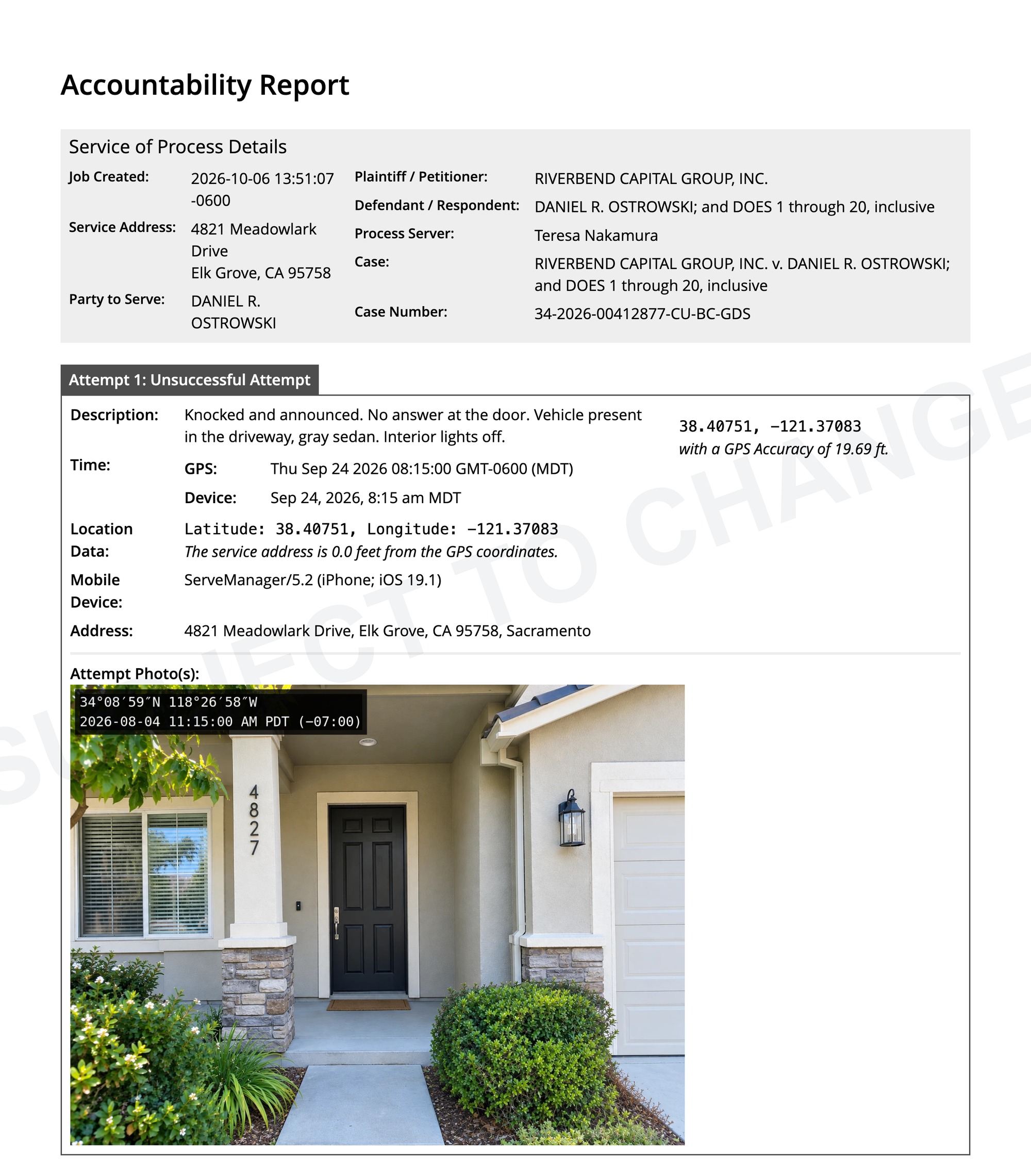
The law (CCP § 417.10(a)): For personal service, substituted service, and unlawful detainer posting, the proof of service must include one or more photos of the site of each effected or attempted service, taken as close to the time of service as practical.
The photo documents the location, not the person. For a home, at least one photo must show the door of the house or apartment. For a business, it must show the door of the specific office of the person being served, not just the front of the building. If service happens somewhere else, such as a parking lot or a public place, the photo shows that site.
On the revised POS-010, the successful-service photo goes in the new Item 8. Photos of unsuccessful attempts go on the POS-012 declaration of diligence when you need to show you tried. Since you won't know ahead of time which attempts will end up there, you need a photo for every one.
How ServeManager Supports This
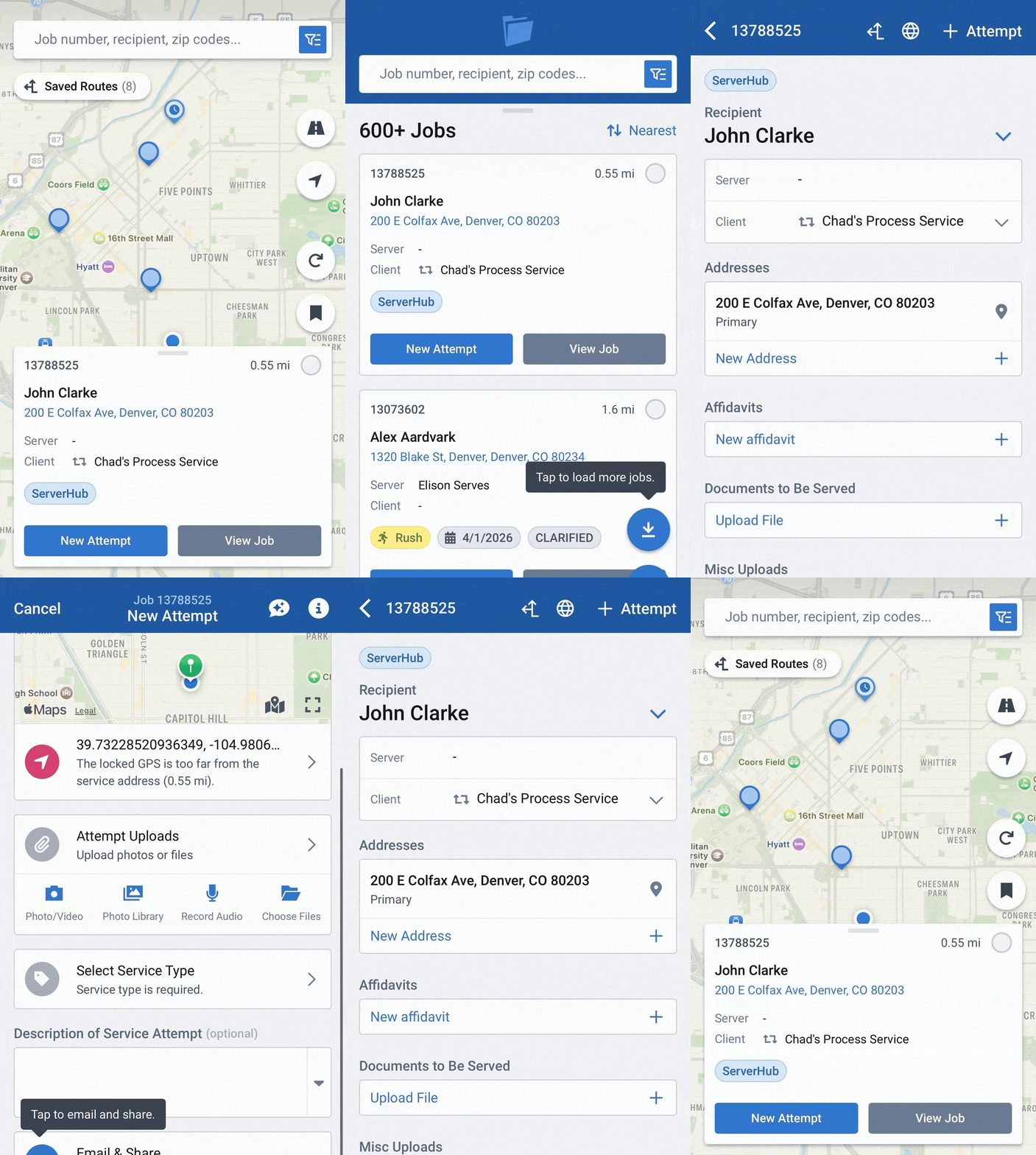
- Photos are part of logging the attempt. In the ServeManager mobile app, the server takes the photo as part of logging the attempt, and it's saved with the attempt's GPS and time. It isn't a separate step to remember later.
- SPARE Act jobs are labeled before the server accepts them. Jobs with California SPARE Act requirements carry a "SPARE Act Required" label, and the accept screen explains what's needed: three attempts on different days and times, with a GPS-stamped photo each time.
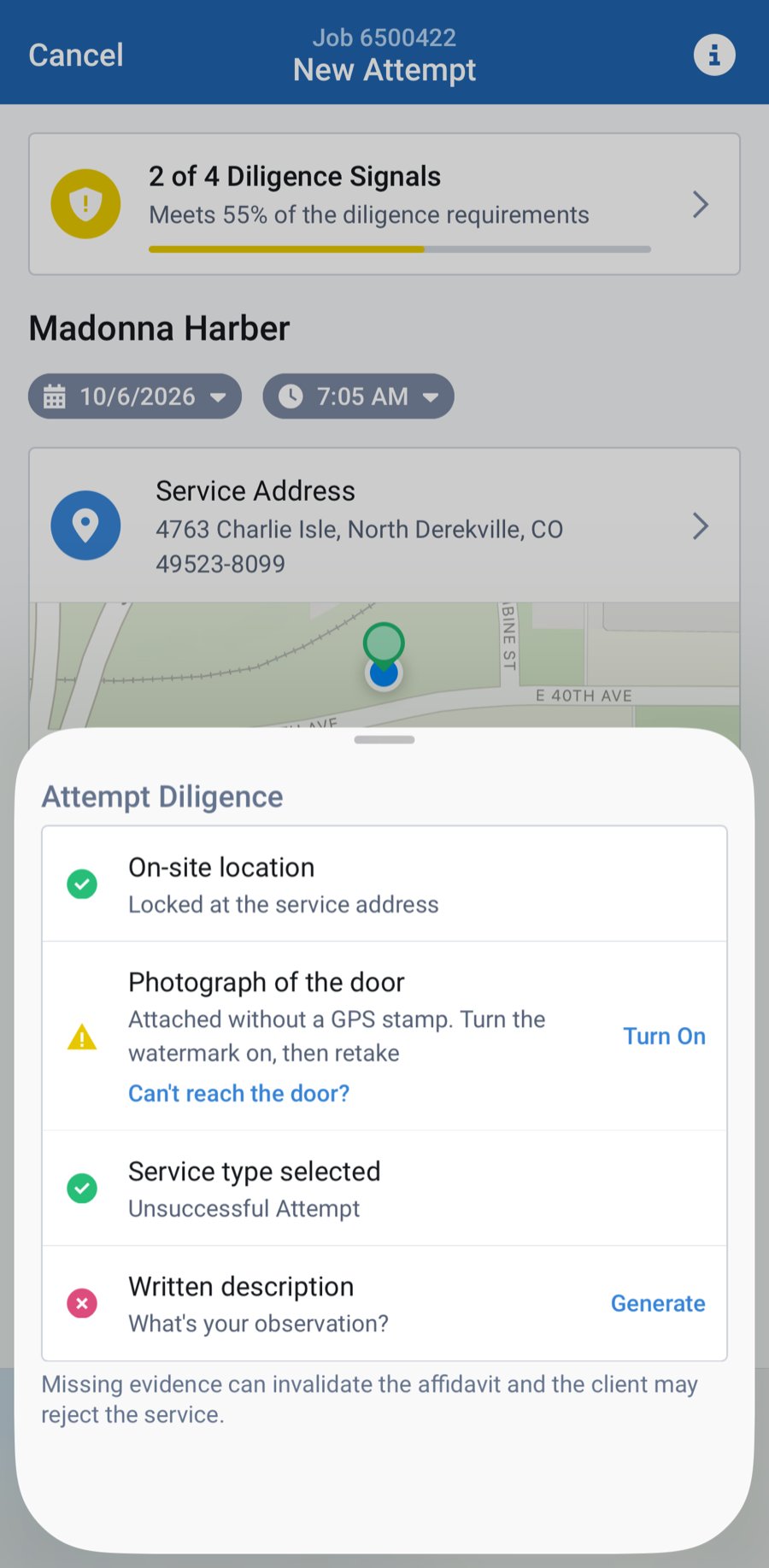
- A live check on every attempt. While logging the attempt, the server sees what's still missing (photo attached, GPS captured, serve type selected, description filled in) before submitting.
- A guided diligence checklist. A state-specific checklist in the attempt screen captures what California requires, including whether the photo shows the door or the entrance.
- Everyone on the job sees the same evidence. Attempt photos are shared with every account on the job (the firm, the agency, and the contractor), so no one has to email photos around.
Requirement 2: A Readable GPS and Timestamp on Every Photo
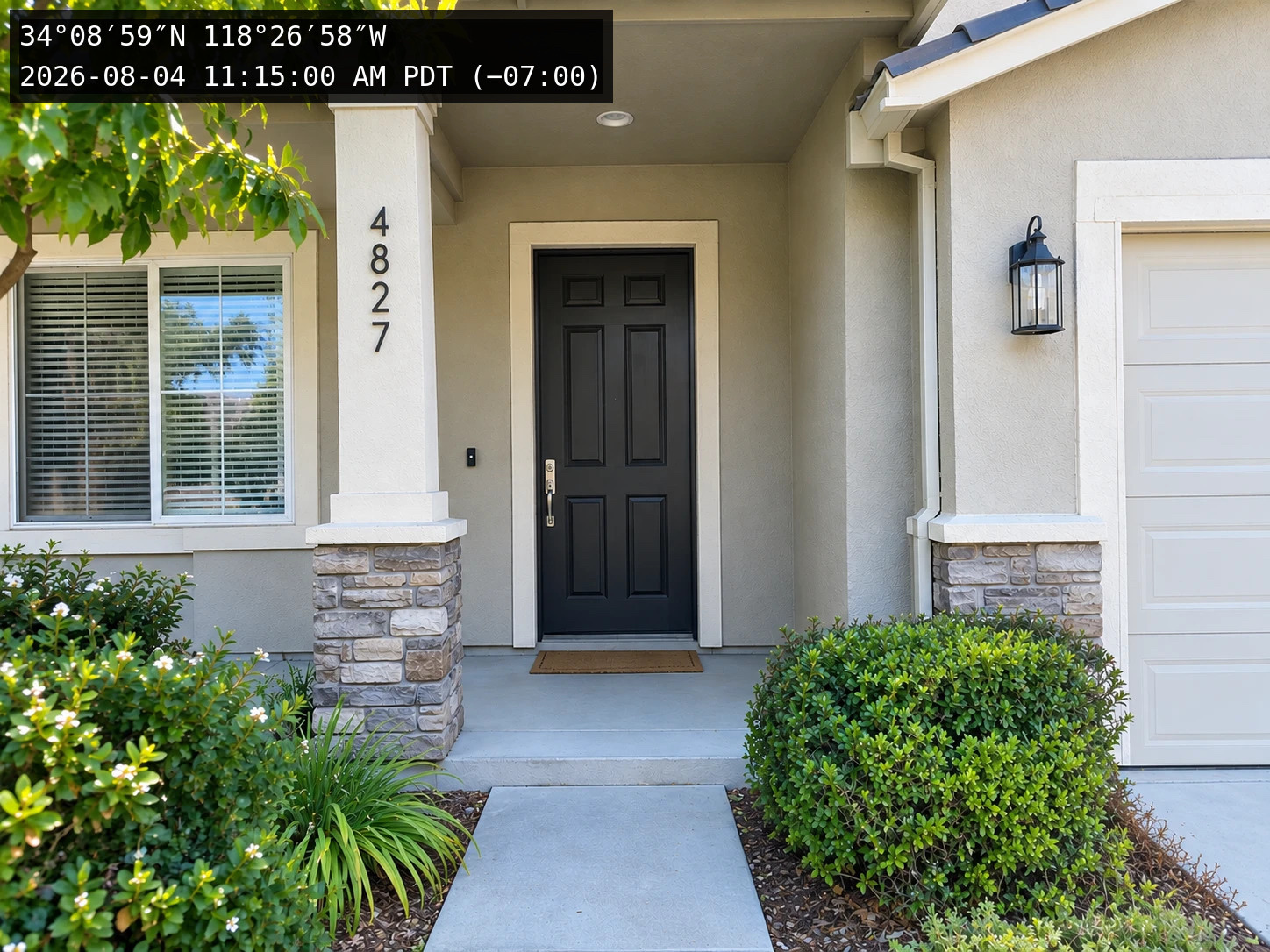
The law (CCP § 417.10(a)(1)(A)): Each photo must contain "a readable stamp that establishes and automatically records the date, time, and global positioning system (GPS) or equivalent coordinates."
Two words in that sentence matter most. Readable means a judge has to be able to see it. The Judicial Council's own draft guidance describes the stamp as "visible, readable lines of text," so information hidden in a photo's file metadata isn't enough. Automatically means the server can't type in the time or location by hand.
How ServeManager Supports This
- The stamp is burned into the image. ServeManager writes the date, time (with time zone), and GPS coordinates directly onto the photo, so the stamp shows up on screen, in the generated proof, and on paper.
- Readable on any background. The stamp scales with the photo's resolution and sits on a high-contrast backing, so it stays legible over bright sky, a dark doorway, or a busy wall, including after the photo is shrunk to fit on the proof. It's also designed with the California Rules of Court font standards in mind (Rule 2.104, Rule 2.105).
- A GPS reading you can trust. ServeManager only accepts GPS readings that meet an accuracy threshold. A weak reading is retried automatically, and one that's still imprecise is flagged as low-confidence instead of being recorded as if it were exact.
- Distance from the address. ServeManager measures how far each attempt's GPS reading landed from the service address, so an attempt that's miles away stands out right away.
Requirement 3: The Three-Attempt Reasonable Diligence Rule
The law (CCP §§ 415.20(b), 415.45(d)): "Reasonable diligence" means attempting personal delivery in good faith on at least three occasions, on three different days, at three different times.
This is the "3-3-3" rule. It applies in two places:
- Before substituted service on an individual (leaving the papers with another adult at the home or office and mailing a copy). It doesn't apply the same way to corporations and other entities, which can be substitute-served without first trying personal service.
- Before a court will allow posting and mailing in an unlawful detainer case.
In consumer debt cases and most unlawful detainer cases, at least one of the three attempts must be at the defendant's home, as long as it's known or could be found with reasonable effort.
One exception carries over: if the only known address is a private mailbox at a commercial mail receiving agency, substituted service can still happen on the first attempt. And the follow-up mailing after substituted service can now go by USPS first-class mail, Priority Mail with tracking, or Certified Mail with return receipt requested.
How ServeManager Supports This
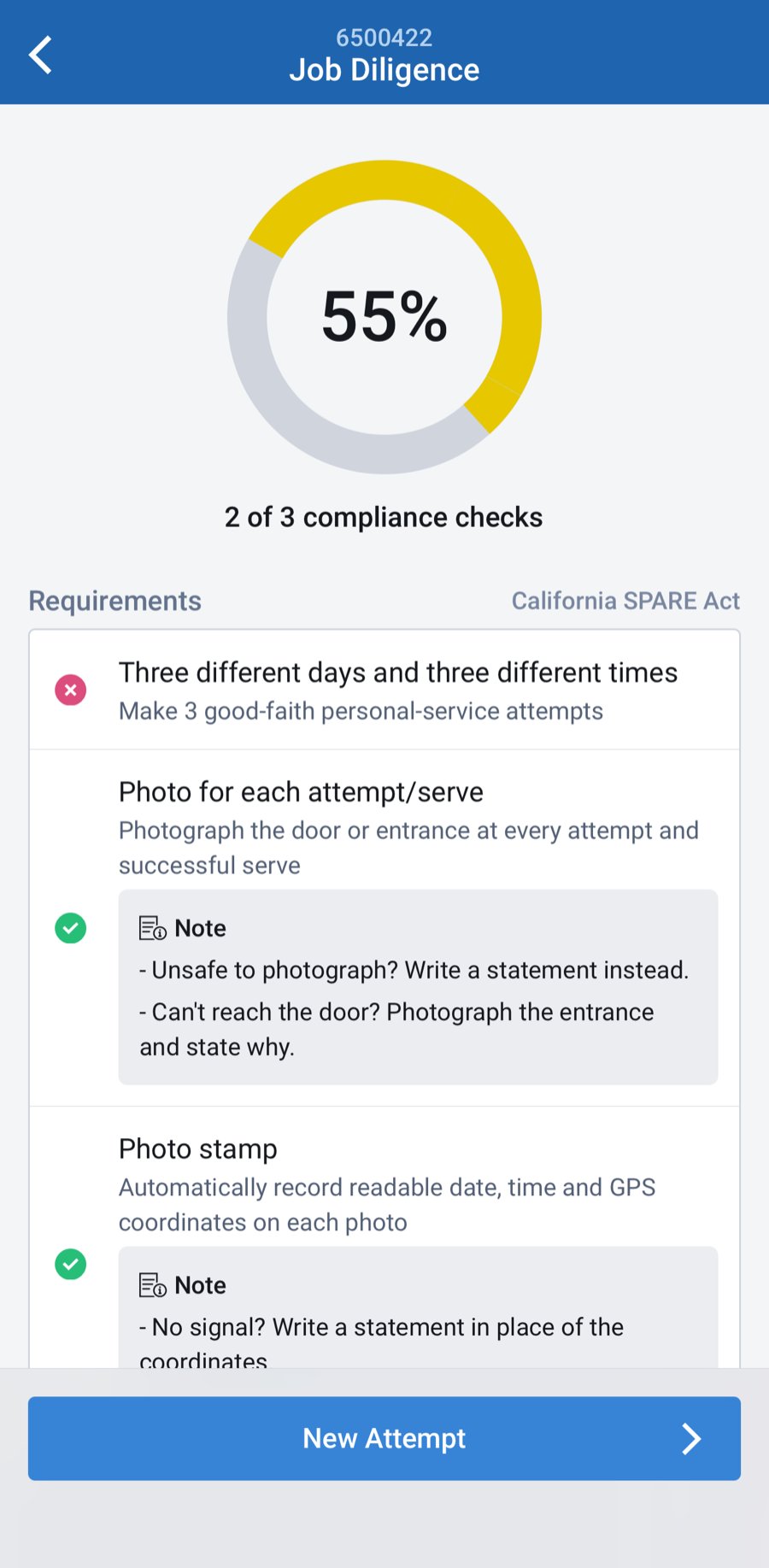
- A running diligence score. ServeManager tracks every attempt on a job, across every device and every account on the job, and scores it against the 3-3-3 pattern while the job is still open. Servers and dispatchers know what's missing before anyone tries substituted service.
- Routes built around the next required attempt. Jobs can be labeled by the attempt window they still need (morning, afternoon, or evening, on a new day), and routes can be ranked by what each job needs next. The server reviews and accepts the suggested route before it takes effect.
- Review before the client sees it. Unsuccessful attempts can go through a diligence review before they're shared with the end client, so what reaches the client is complete.
- A complete attempt history. Every attempt keeps its date, time, address, description, stamped photo, and GPS on one timeline. That's the same structure the new POS-012 declaration uses.
Requirement 4: The New Judicial Council Forms (POS-010 and POS-012)
Most of the new documentation lands on two forms:
- POS-010, Proof of Service of Summons (revised). Adds Item 8, "Photo of the location of service," which is required for personal service, substituted service, and UD posting. It has checkboxes for whether the photo has a GPS stamp (or why not), whether it shows the door or the entrance (and why), and a safety exception. It also adds a separate item for UD posting and the new mailing options.
- POS-012, Declaration of Diligence (new, optional). Lays out each personal-service attempt (date, time, and address), with a photo item for each attempt. It's used to justify substituted service or to ask the court for UD posting. Each server who attempted service fills out their own.
California allows computer-generated versions of proof of service forms (Rule of Court 2.150), so software can produce them directly from the job record.
How ServeManager Supports This
- Proofs filled in from the job. ServeManager already generates California's POS-010 with an attached declaration of diligence, filled in from the job, the attempts, and the server's credentials. Nobody re-types attempt details.
- Updated forms for 2027. ServeManager will ship the revised POS-010 and the new POS-012 once the Judicial Council adopts them, ahead of January 1, 2027. They'll include a separate POS-012 for each server when more than one server worked the job.
Requirement 5: The Evidence Goes Into the Proof
The photos and explanations aren't optional backup kept on file. The law requires them "on or with" the proof of service (CCP § 417.10). That only works at scale when the evidence gathered in the field flows straight into the document the server signs.
How ServeManager Supports This
- From attempt to proof, no downloads. Stamped photos, GPS, attempt descriptions, and any exception explanations are stored with the attempt, and ServeManager places them in the generated proof as labeled attachments. Nobody has to pull photos off a phone and attach them by hand.
- Ready to sign and file. The finished proof and declaration of diligence come out with the evidence already attached.
Requirement 6: Documented Exceptions (Safety, No Signal, and Door Access)
The law allows three documented exceptions. None of them lets a server skip documenting the attempt:
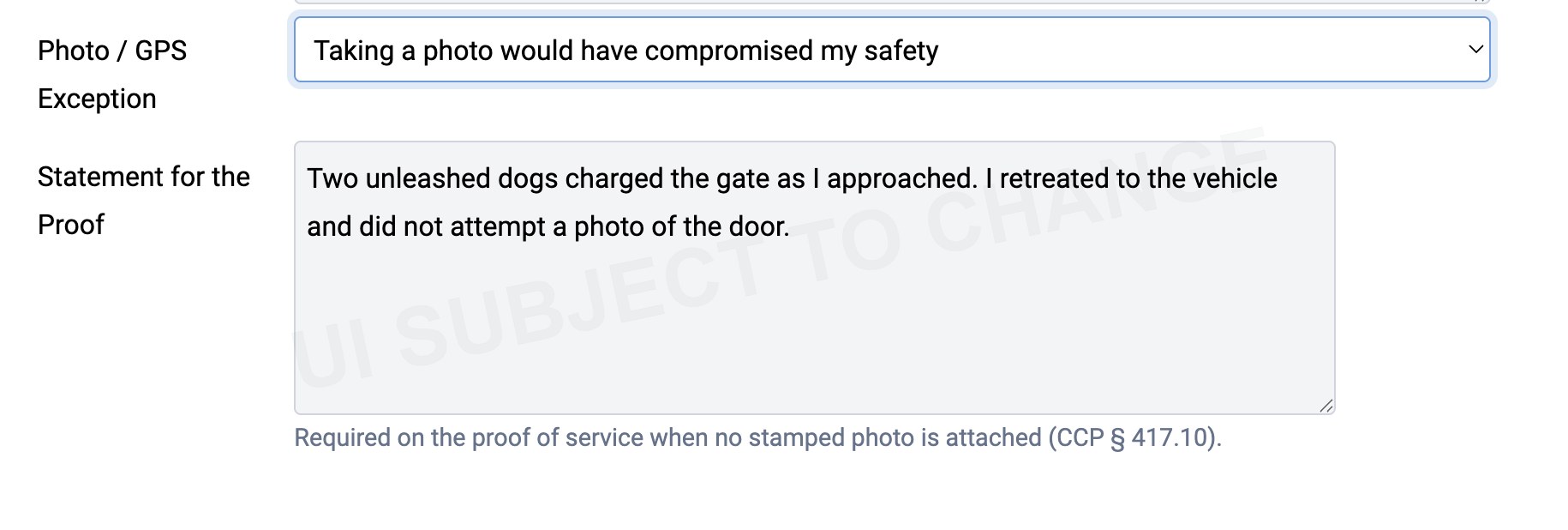
- Safety. If taking a photo would reasonably compromise the server's safety, no photo is needed, but the server must still document the attempt and give a detailed statement explaining why (§ 417.10(a)(4)).
- No GPS or cell signal. The photo is still required. The server adds a detailed statement explaining why the stamp has no GPS coordinates (§ 417.10(a)(1)(B)).
- Door not accessible. If the server photographs the building or office entrance instead of the door, they must explain specifically why the door couldn't be reached (§ 417.10(a)(2)(C)).
How ServeManager Supports This
- Explanations captured at the time of the attempt. When an attempt is missing GPS or a photo, ServeManager asks the server for the reason right then and saves it to the attempt. The explanation the court requires is already written when the proof is generated.
- Automatic flags on every job. Any attempt missing GPS or a photo is flagged for diligence review automatically, for every agency, not only teams that check by hand.
- Low-confidence GPS is labeled honestly. A weak GPS reading is recorded as low-confidence, not presented as precise.
Requirement 7: Registration on Every Proof, and a Public Registry
Registration thresholds haven't changed (Business & Professions Code § 22350). Two things are new:
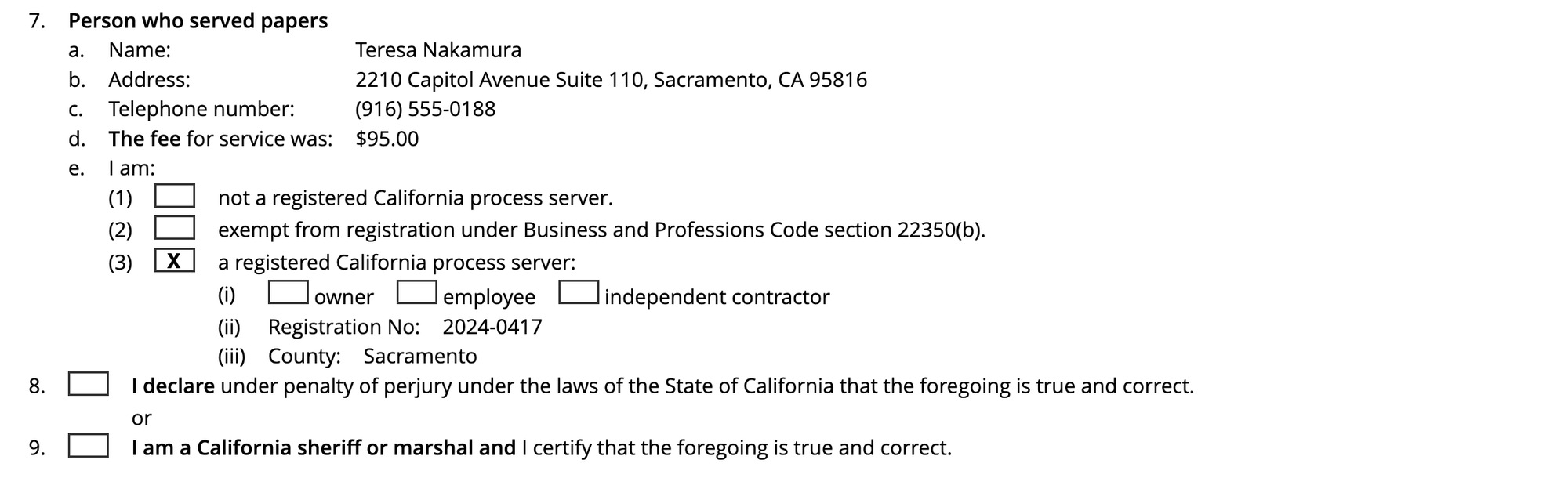
- Any proof signed by someone who is required to be registered (or by their employee or contractor) must show the server's registration number (CCP § 417.40).
- Each county clerk's register of process servers must be publicly available, so anyone can check a server's registration, and challenge it if it's out of date (B&P § 22355).
How ServeManager Supports This
- Registration details on every proof. Each server's California registration number and county are stored on their ServeManager credentials and printed on every California proof automatically.
- No missing county. County of registration is now a required field for California servers, and existing records have been backfilled, so no proof goes out incomplete.
Beyond Compliance: Catching Sewer Service Before It Reaches Court
The SPARE Act exists because fraudulent service hurts real people. As a process serving agency you can go a step further, looking for patterns that give sewer service away:
- Attempts too far apart to drive between in the time recorded
- GPS readings far from the service address
- The same GPS coordinates reused across different addresses
- Bursts of attempts entered all at once instead of in the field
- A device clock that doesn't match the reported attempt time
Is ServeManager SPARE Act / AB 747 Compliant Software?
ServeManager is built to capture everything AB 747 requires as part of serving the job, not as paperwork afterward: GPS-stamped photos of every attempt, the door-or-entrance record, three-attempt diligence tracking, documented exceptions, registration details, and the updated POS-010 and POS-012 forms. Staying compliant still depends on the server doing the work in the field. ServeManager makes sure that work is captured, checked, and filed the same way on every job.
Ready for the SPARE Act? Here's Where to Start.
The SPARE Act is changing what process serving looks like, and having the right tools makes compliance much easier. Here's where to go next:
- Process serving agencies: If you need software that's ready for the SPARE Act, ServeManager handles job management, documentation and reporting for you, so you can stay compliant without slowing down.
- Law firms: InfoTrack connects you with agencies that use ServeManager to meet SPARE Act requirements. You can order, track and manage service from one place.
- Private parties and small businesses: Need to hire a process server? ServeNow uses an AI ordering assistant to walk you through every step and connect you with a qualified server near you.
Frequently Asked Questions
What Is the SPARE Act (AB 747)?
A California law, signed in October 2025, that reforms civil service of process to prevent "sewer service." Starting January 1, 2027, proofs of service must include a GPS- and time-stamped photo of each service attempt, and substituted service on an individual requires three good-faith attempts on three different days at three different times.
When Does the SPARE Act Take Effect?
January 1, 2027. Proofs filed before then aren't invalid just because they lack a photo.
Does the SPARE Act Require GPS Coordinates on Service Photos?
Yes. Each photo needs a readable stamp showing the date, time, and GPS (or equivalent) coordinates, recorded automatically. If there's no GPS or cell signal, the photo is still required, along with a detailed explanation of why the coordinates are missing.
What Does the Photo Need to Show?
The location, not the person. At a home, the door of the house or apartment. At a business, the door of the specific office. If the door can't reasonably be reached, a photo of the entrance plus an explanation of why.
What Is the AB 747 Three-Attempt Rule?
Before substituted service on an individual, or before a court allows posting in an unlawful detainer case, the server must attempt personal delivery in good faith at least three times, on three different days, at three different times. In consumer debt cases, at least one attempt must be at the defendant's home if it can be found.
What Happens If a Defendant Says They Were Never Served?
If the defendant offers evidence of improper service, the proof of service is no longer presumed correct, and the party that obtained the default must prove service was lawful. A void default can be challenged at any time.
Is ServeManager SPARE Act Compliant Software?
ServeManager is built to capture everything AB 747 requires: stamped photos of every attempt, three-attempt diligence tracking, documented exceptions, registration details, and the updated POS-010 and POS-012 forms, all generated straight from the job.